


What Is an Investment Thesis?
A plain-English definition of an investment thesis: what it is, what goes in one, a simple example, and why writing it down makes your reasoning reviewable.
An investment thesis is the written reason a position belongs in your portfolio: why you own it, what has to stay true, and what would make you change your mind.
That is the whole idea. It does not need to be long, and it does not need to read like an analyst report. A thesis is simply your reasoning, written down before price movement, news, and emotion start rewriting your memory of why you bought.
This article is educational only. It is not financial advice and does not tell you what to buy, sell, or hold.
Investment Thesis, Defined
An investment thesis is a clear statement of the argument behind a position. A complete one answers three questions:
- Why does this asset deserve a place in my portfolio?
- What has to remain true for that to keep making sense?
- What evidence would tell me the thesis is broken?
The professional world uses the same idea at a larger scale. A fund manager writes a thesis before allocating capital; a venture investor writes one before backing a startup. The format scales down cleanly to a single investor and a single holding. What makes it a thesis rather than a hunch is that it is specific enough to be proven wrong.
That last part is what separates a thesis from a story. “AI is the future” or “gold protects wealth” is a theme. A thesis connects the theme to a specific asset, a role in your portfolio, the evidence behind it, the risks you are accepting, and the signal that would make you review it.
Why Write One?
Because the biggest gap in investing is usually not stock selection — it is behavior.
Every year, Morningstar’s Mind the Gap study compares the return of the average fund to the return the average investor actually earned in that fund. Over the decade ending December 2024, the average dollar earned about 7.0% per year while the funds themselves returned 8.2% — a gap of roughly 1.2 percentage points a year, or about 15% of the total return, given up mostly to buying and selling at the wrong times. (The exact size of that gap is debated by researchers, but its direction — investors underperforming their own funds — is consistent across editions.)
The cost of mistiming shows up starkly when you look at how few days matter. J.P. Morgan’s analysis of a 20-year stretch of the S&P 500 found this:
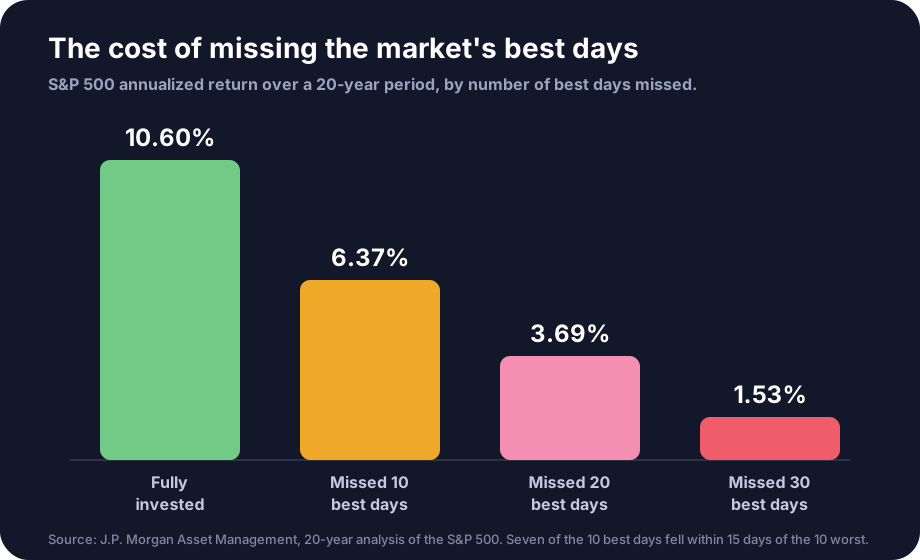
Seven of those 10 best days fell within 15 days of the 10 worst days. In other words, the moments most likely to make you sell in fear sit right next to the moments that drive most of the return. A written thesis will not make markets calmer, but it gives you a standard set before the fear arrives: instead of reacting to a red screen, you check whether the reason you bought is still intact.
A thesis is a decision you make in a calm moment to help the version of you that is not calm. It turns "should I panic-sell?" into a checkable question: has anything in my written reasoning actually changed?
What Goes in an Investment Thesis
Most useful theses have the same six parts. You do not need a template to start, but a consistent shape keeps every position honest.
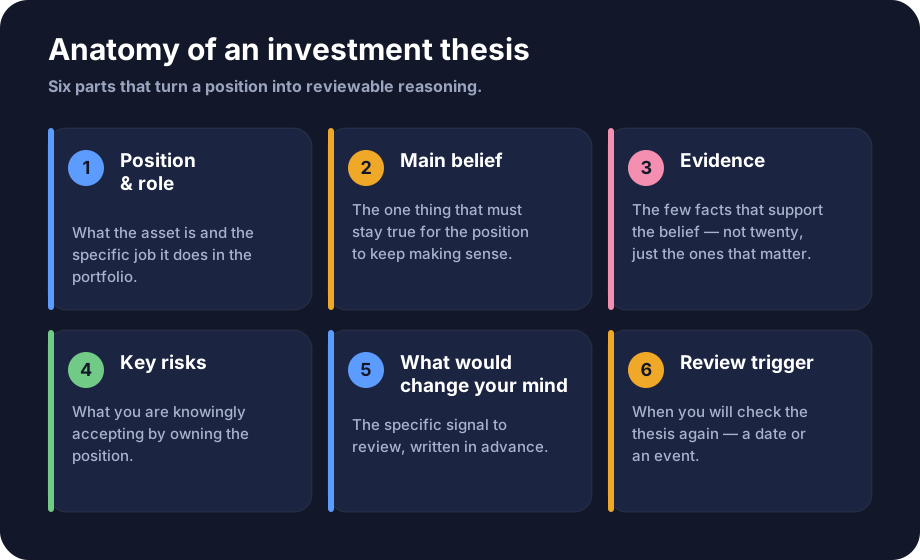
- Position and role — what the asset is, and the specific job it does (core, income, hedge, speculative satellite, cash reserve).
- Main belief — the one thing that must stay true for the position to make sense.
- Evidence — the few facts that support the belief, not twenty.
- Key risks — what you are knowingly accepting by owning it.
- What would change your mind — the specific signal to review, written in advance.
- Review trigger — when you will check the thesis again: a date or an event.
If you want the step-by-step version with worked examples, read how to write an investment thesis, or start from the reusable investment thesis template.
A Short Investment Thesis Example
Here is a fictional example, included only to show the shape:
Position: A broad global equity ETF. Role: The core of my portfolio — diversification, not excitement. Main belief: Over a 10-year-plus horizon, low-cost broad exposure is the most reliable way for me to participate in global growth. Evidence: Low expense ratio, wide diversification across regions and sectors, and a methodology I understand. Key risks: Prolonged flat markets, currency exposure, and my own temptation to tinker. What would change my mind: The fund’s cost rises materially, its index methodology changes, or its role no longer fits my goals. Review trigger: Once a year, and any time it drifts far from my target allocation.
Notice it is not trying to be impressive. It is trying to be useful — clear enough that a year from now you can check it against reality.
Investment Thesis vs. a Stock Tip
A tip tells you what to buy. A thesis tells you why, and — crucially — how you would know you were wrong.
That difference matters most when a position moves against you. With only a tip, a falling price leaves you with nothing but emotion to act on. With a thesis, you have a written reason to compare against the new facts. A stock can fall while the thesis stays perfectly intact; a stock can rise while the thesis quietly breaks. Without the original reasoning on paper, it is almost impossible to tell those apart.
Does It Work for ETFs, Crypto, and Cash?
Yes — the role just changes. A thesis is not only for individual stocks.
- An ETF thesis is usually about the role, cost, and methodology, not a company catalyst.
- A crypto thesis has to be honest about volatility, custody, regulation, and whether the use case is durable.
- A commodity thesis is often about diversification or an inflation and currency hedge.
- Cash has a thesis too: its job is flexibility, and its risk is inflation and missed upside.
The mistake is using one kind of thesis for everything. A cash reserve does not need a growth story, and a speculative bet should not be judged like a core holding.
How Horyzon Fits
Most trackers show what you own and what it is worth. Horyzon is a portfolio tracker built around the reason behind each position.
You can track stocks, ETFs, crypto, commodities, and cash, and write the thesis for each holding so it sits beside the asset instead of getting buried in a notes app, a spreadsheet, or your memory. That makes it an investment thesis tracker: when the price moves, the reason you bought is one glance away. Over time, the way you actually build and review positions even shapes your Investing Persona.
Start with the investment thesis template, then turn it into a habit: write the thesis when you add the position, and review it when the evidence changes — not when the price does.