


How to Write an Investment Thesis Before You Buy
A practical guide to writing an investment thesis: why you own a position, what must stay true, what could break the thesis, and when to review it.
An investment thesis is the written reason a position belongs in your portfolio.
It does not need to be long. It does not need to sound like an analyst report. The point is simpler: before price movement, news, and emotion start changing your memory, write down why you own the asset and what would make you review that decision.
This article is educational only. It is not financial advice and does not tell you what to buy, sell, or hold.
New to the idea? Start with what an investment thesis is, then come back here for the step-by-step version.
What an Investment Thesis Should Do
A useful thesis answers three plain questions:
- Why does this position deserve a place in my portfolio?
- What has to remain true for the position to keep making sense?
- What evidence would make me change my mind?
That last question is the one many investors skip. A thesis without a review trigger is easy to defend forever. If the price goes up, the thesis feels brilliant. If the price falls, the thesis suddenly becomes “long term.” Writing the review trigger ahead of time gives future-you a clearer standard.
The goal is not to predict perfectly. The goal is to make your reasoning reviewable.
Start With the Role of the Position
Before writing the thesis, name the job the asset is supposed to do.
A position might be:
- a long-term growth holding
- an income holding
- a broad market core
- a cash reserve
- an inflation hedge
- a higher-risk satellite
- a currency or country exposure
- a position you are studying before adding more
The same asset can make sense for one investor and make no sense for another because the role is different. A volatile stock might be acceptable as a small satellite but uncomfortable as the center of a portfolio. Cash might look boring until its role is flexibility.
Write the role first. It keeps the rest of the thesis honest.
How to Structure an Investment Thesis
There is no official format for an investment thesis. What matters is that the structure forces you to write both the upside and the exit. The six parts below are a reliable shape; if you want a reusable version, Horyzon also has an investment thesis template built around the same idea. For most positions, this six-part structure is enough.
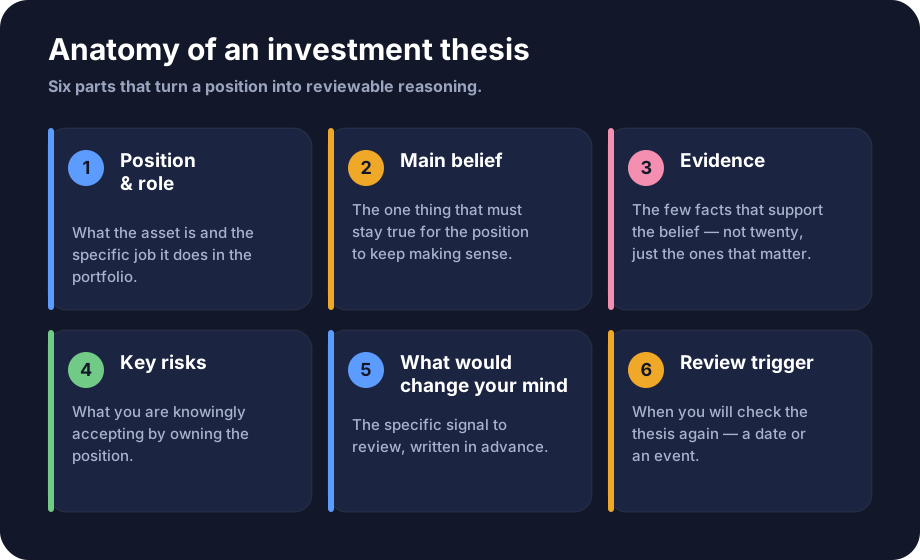
1. Position and Portfolio Role
Write what the position is and why it exists in the portfolio.
Example:
I own this ETF as part of the broad market core of my portfolio. Its job is diversification, not excitement.
Another example:
I own this stock as a higher-risk growth position capped at a small allocation.
This stops every holding from being judged by the same standard. A core ETF, a speculative stock, a crypto asset, and a cash position should not all be expected to behave the same way.
2. The Main Belief
This is the heart of the thesis. Write the belief that must be true for the position to make sense.
Examples:
- The company can grow revenue without destroying margins.
- The ETF gives me efficient exposure to a market I want to hold for years.
- The asset protects optionality because I may need cash within the next year.
- The commodity position helps diversify against currency or inflation risk.
Keep it plain. If you cannot explain the belief without buzzwords, you may not understand it well enough yet.
3. Evidence Behind the Belief
A thesis should not be a feeling wearing a suit.
List the evidence that supports the main belief. This might include:
- revenue growth
- margins
- balance sheet strength
- valuation compared with your expectations
- customer retention
- competitive advantage
- index methodology
- diversification role
- currency exposure
- liquidity needs
- dividend history
- earnings or cash flow quality
You do not need twenty data points. Pick the few that actually matter. A thesis becomes harder to review when everything is listed as important.
4. Key Risks
Write the risks clearly, even if you still decide to own the position.
For a stock, the risk might be competition, valuation, debt, regulation, execution, cyclicality, or management quality.
For an ETF, the risk might be concentration, country exposure, currency exposure, sector exposure, fees, or tracking error.
For crypto, the risk might be volatility, custody, regulation, liquidity, security, or the possibility that the original use case never becomes durable.
For cash, the risk might be inflation, missed upside, or currency depreciation.
Risks do not automatically kill a thesis. They define what you are accepting.
5. What Would Change Your Mind
This is the most valuable part of the thesis.
Write the evidence that would make you reduce, sell, stop adding, or review the position. It should be specific enough that you can recognize it later.
Weak version:
I will sell if the company gets worse.
Better version:
I will review the position if revenue growth slows for two consecutive quarters while margins also compress.
Weak version:
I will hold this ETF forever.
Better version:
I will review this ETF if its country or sector concentration no longer matches the role I want in my portfolio.
You are not promising to act automatically. You are defining what deserves attention.
6. Review Date or Review Trigger
A thesis gets stale. Give it a review rhythm.
That could be:
- after each earnings report
- once per quarter
- once per year
- when the position passes a target allocation
- when a key metric changes
- when your personal goal changes
- when the original time horizon ends
The review date matters because an old thesis can survive long after the facts have changed.
Morningstar's Mind the Gap study finds the average fund investor earns roughly a percentage point a year less than the funds they own — about 15% of the total return — mostly from buying and selling at the wrong moments. A written thesis with a review trigger is a small habit aimed directly at that gap: it replaces "the price is scary" with "has my reason actually changed?"
A Simple Investment Thesis Example
Here is a fictional example. It is only for structure.
Position: ExampleCo
Role: Higher-risk growth position, capped at 5 percent of the portfolio.
Main belief: ExampleCo can grow revenue faster than the market expects while keeping margins healthy.
Evidence: Revenue has been growing, customer retention appears strong, and the company operates in a market that may keep expanding.
Key risks: Valuation is demanding, competitors are well funded, and the company could spend too aggressively to maintain growth.
What would change my mind: I will review the position if revenue growth slows for two consecutive quarters, gross margin weakens materially, or debt rises faster than revenue.
Review plan: Review after each earnings report and any time the position grows above the target allocation.
This thesis is not trying to be impressive. It is trying to be useful.
Common Mistakes
The first mistake is writing a thesis that only explains the upside. If the downside is missing, the thesis is not finished.
The second mistake is confusing a story with a thesis. “AI will be huge” or “gold protects wealth” might be a theme, but it is not yet a thesis. A thesis connects the theme to the specific asset, role, price, risk, and review trigger.
The third mistake is letting price movement rewrite the original reason. A stock can go up while the thesis gets weaker. A stock can go down while the thesis remains intact. Without the original reason written down, it is hard to separate price from evidence.
The fourth mistake is using the same thesis for every asset. A cash reserve does not need a growth story. A broad ETF does not need a company-specific catalyst. A speculative asset should not be treated like a core holding unless you are willing to accept that risk.
How Horyzon Fits
Horyzon is built around the idea that a portfolio is more than a balance. You can track stocks, ETFs, crypto, commodities, and cash, but also write the reason behind each position.
That makes Horyzon useful as an investment thesis tracker: the thesis sits beside the holding instead of getting buried in a notes app, spreadsheet, or memory.
If you want to start with the structure first, use the investment thesis template. Then turn it into a habit: write the thesis when you add the position, review it when evidence changes, and keep the reason visible while the price moves.