


Asset and role
What is the position, and what job should it do in your portfolio?
Example: Long-term growth position, income holding, cash reserve, inflation hedge, or higher-risk satellite.
Investment thesis template
Use this structure to make a position reviewable: why you own it, what must stay true, what would change your mind, and how it fits the rest of your portfolio.
Quick thesis
Position
ASML Holding
Why I own it
Monopoly-like position in EUV lithography, with long-term demand tied to advanced chips.
Review trigger
Thesis needs review if order backlog weakens for multiple quarters.
The template
You do not need a long essay. A clear thesis is often a few honest paragraphs and a specific review trigger.
What is the position, and what job should it do in your portfolio?
Example: Long-term growth position, income holding, cash reserve, inflation hedge, or higher-risk satellite.
Write the plain-language reason you bought or kept the asset.
Example: I own this because I believe the company can keep expanding margins while revenue grows.
Summarize the main belief that must remain true for the position to make sense.
Example: The business can compound earnings faster than the market expects over the next five years.
Define the evidence that would make you reduce, sell, or review the position.
Example: Revenue growth stalls for several quarters, debt rises sharply, or the competitive advantage weakens.
How long are you willing to let the thesis play out, and when should you review it?
Example: Review after the next two earnings reports, or once the position reaches a target allocation.
Name the biggest risks instead of hiding them in the back of your mind.
Example: Valuation risk, concentration risk, regulation, currency exposure, or execution risk.
Thesis checklist
A thesis is useful when it creates a future review path. These are the checkpoints Horyzon is designed to keep close to each position.
From draft to review
Build a thesis you can revisit later.
Asset role
What job should this position do?
Core thesis
What must stay true?
Risk notes
What could go wrong?
Review trigger
What would change your mind?
Next review
When should you revisit it?
How Horyzon helps
Horyzon turns this template into a habit. You can track the asset, write the thesis, and revisit the reason later when price movement starts to distort memory.
Write the reasoning directly beside the stock, ETF, crypto asset, commodity, or cash holding.
Make it clear what evidence would change your mind before emotions take over.
See whether a position is a core holding, hedge, cash reserve, or higher-risk satellite.
Horyzon Pro can answer questions using your holdings and the thesis you wrote.
In the app
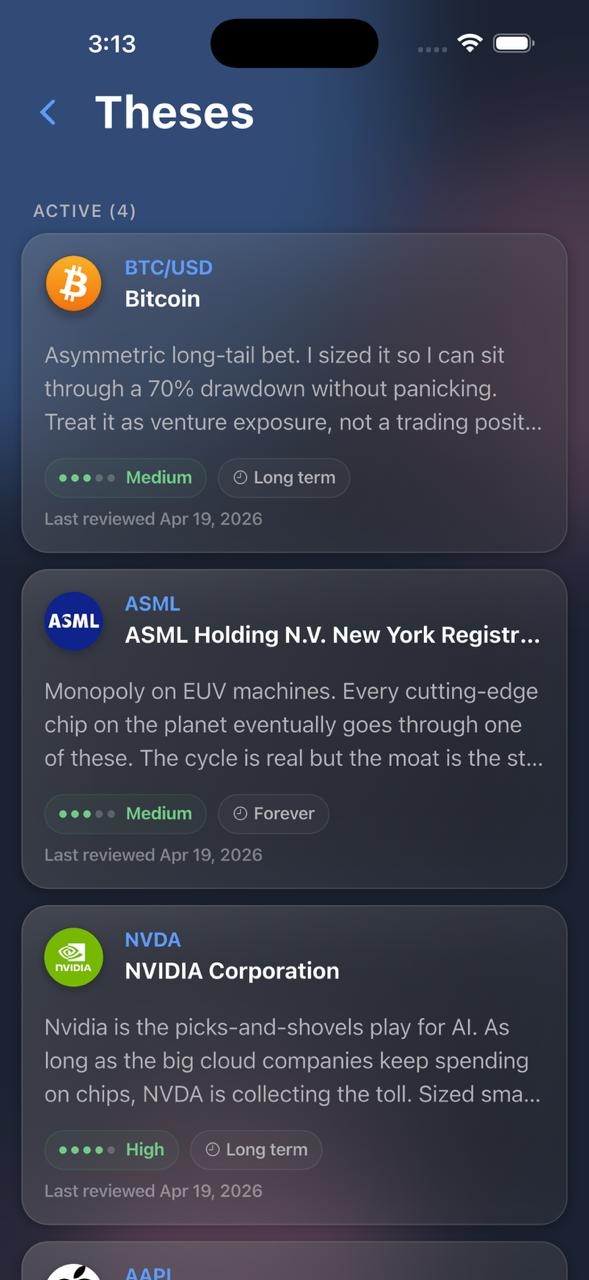
The template becomes useful when it sits next to the asset. These screens show the thesis list and the portfolio context those theses support.
Theses
Keep conviction, review triggers, and risk notes close to the asset.
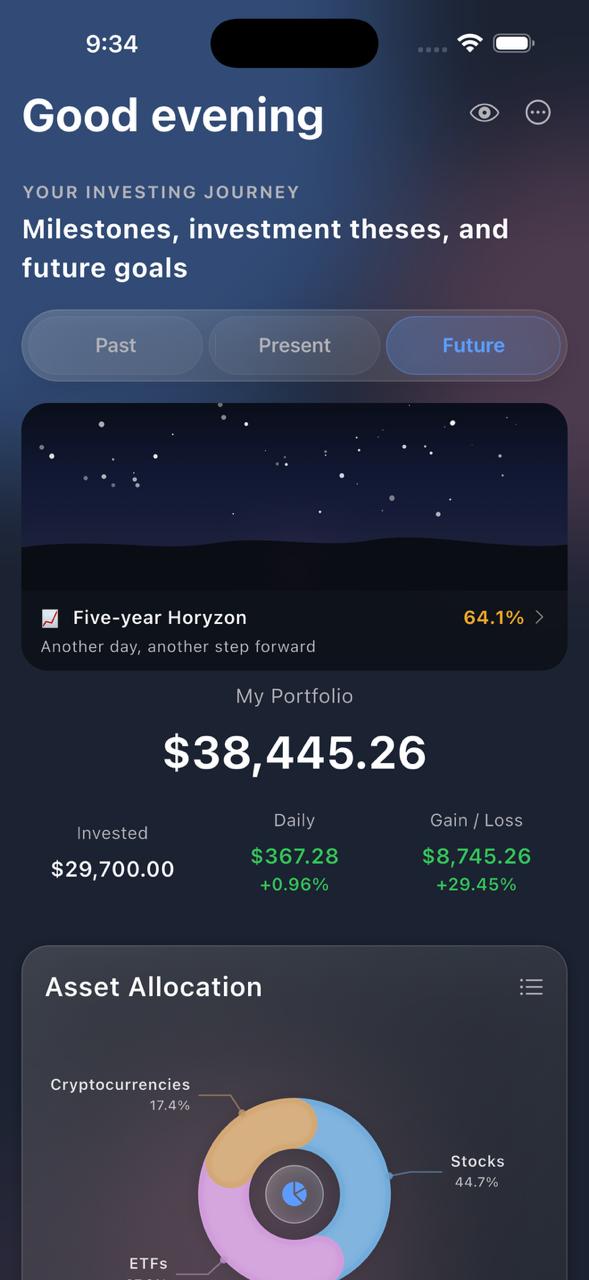
Portfolio
Connect the written thesis to allocation, progress, and daily movement.
Example
This example is made up for structure only. It is not a recommendation.
A useful investment thesis usually includes why you own the asset, what must stay true, what would change your mind, the role of the position, key risks, and a review date.
Yes. The same structure can work for stocks, ETFs, crypto assets, commodities, and cash, as long as the thesis explains the role of the asset and the risks you are accepting.
No. Horyzon helps you record and review your own reasoning. It is for portfolio tracking and informational analysis only, not financial advice.
SEO topic cluster
These pages explain Horyzon through specific search intents: writing investment theses, tracking manually, using AI with context, and keeping portfolio decisions reviewable.
Start with the definition, the six parts of a thesis, and a short example.
Use a practical guide for turning a position idea into a reviewable thesis.
Use a practical template for writing why you own a position and what would change your mind.
Write why you own each stock, ETF, crypto asset, commodity, or cash position.
Discover what kind of investor you are, built from your real holdings and theses.
See how AI insights become more useful when they can reference holdings and written theses.
Track a mixed portfolio without broker sync, account scraping, or forced connections.
See the countries, exchanges, asset classes, and currencies Horyzon supports.
Understand how Horyzon uses AI context, thesis data, and privacy boundaries.
See how Horyzon brings theses, goals, AI insights, widgets, and market data together.